
How to Treat Marionette Lines at Home and in Clinic
To treat marionette lines, you have two main routes: simple home care and clinic treatments. Sun care and the right...
Read More
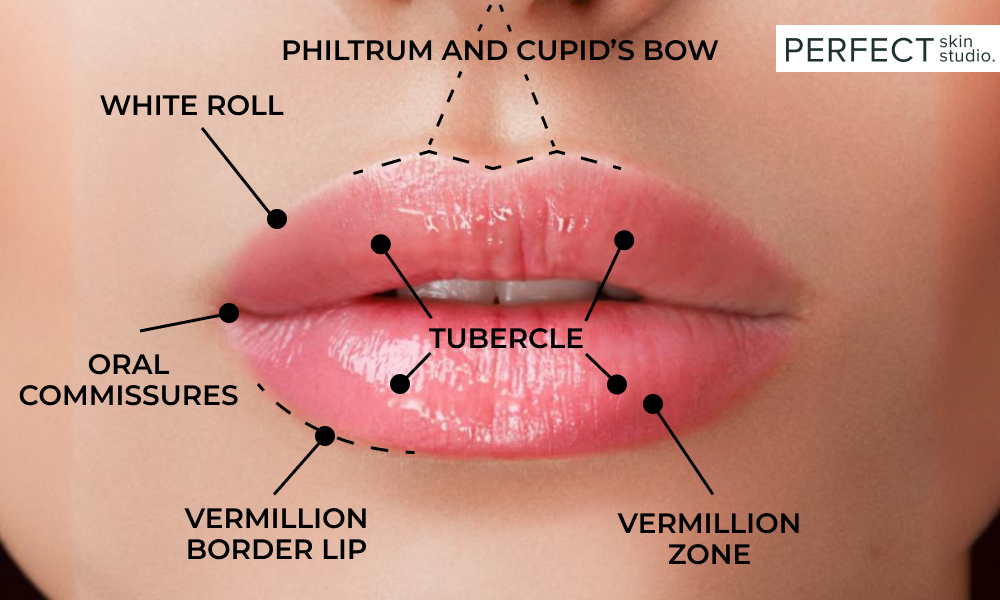
Lips play a bigger role in everyday life than most people realise. They help us speak clearly, eat comfortably, sense temperature, and express emotion, all while shaping the overall appearance of the face. Despite this, the structure of the lips is often overlooked.
Lip anatomy involves more than just visible shape or colour; it includes muscles, nerves, blood supply, and distinct landmarks that work together to support function and appearance. Understanding how lips are built makes it easier to appreciate why they change with age, why they are so sensitive, and why precision matters in medical and cosmetic treatments. This guide explains lip anatomy in a simple, practical way that’s easy to understand.
Lip anatomy is the study of the structure of the lips, including their tissues, muscles, nerves, and blood supply, and how they connect to the mouth and surrounding facial features. It explains how lips function in speaking, eating, and expression while also contributing to facial appearance. Physically, the lips form the natural boundary between the outside of the face and the inside of the mouth.
Lips are not just skin and hue. They are sensory organs, expressive muscles, instruments of speech mechanics, and in areas like dentistry, plastic surgery, and dermatology, crucial structures that influence well-being as much as looks. So when it comes to information about lips, the main thing that is important to know refers to their construction:
A good knowledge of the anatomy of the lips can enable a clinician to avoid unwarranted complications in procedures like dermal injections and reconstructive surgeries.
Lips consist of three main ingredients:
Upper Lip
A cleft of the upper lip is situated below the nose and extends to the opening of the orifice. It’s generally smaller than the lower lip and with its matte pout includes signature landmarks like the philtrum (the vertical groove) and Cupid’s bow (that well-known double curve).
Lower Lip
The lower lip is also above the chin. In most people, it is fuller than the upper lip and is a key player in expression, as well as speech.
The upper and lower lips are combined to create the immediate exterior of the mouth. They’re soft and pliable, and are very well endowed with nerve and blood supply.
The following are the key components of lip structure you should be familiar with.
Vermillion Border Lip
The vermilion border lip is that region along the lip's edge. This is the distinct border where the coloured part of the lip meets the skin on your face. It’s one of those places where lipstick is so often applied because it so beautifully clarifies shape.
Vermillion refers to the reddish appearance of the lip line (mucosal margin) of a normal mouth, caused by a thickened epithelium containing fairly superficial capillaries.
Vermillion Zone
Within the vermillion border, there is the vermillion zone, red or pink lip flesh. There’s no hair in this area, and no sweat glands or the normal skin oils your body produces, which is why lips can dry out easily and become chapped.
Philtrum and Cupid’s Bow
The philtrum is the vertical groove that runs from the nose to the top of the upper lip and defines a pec of lips. Under that is the Cupid’s bow, a soft double curve in the middle of the upper lip that gives shape to what many people consider an appealing kind of lip.
Oral Commissures
These are the angles where the upper and lower lips converge on both sides. They help to shape expressions like smiling, frowning, and speaking.
White Roll and Tubercle
The white roll is a thin strip that runs along the vermillion border of the upper lip. It provides a definition and can be a guide to cosmetic planning. And, on top of that, little rounded bumps called tubercles (most notably on the upper lip) add to plumpness and form.
Muscles and Movement
Underneath, the lips are moved by external and internal muscles too, in particular something called the orbicularis oris, a ring of muscle that acts like a sphincter around the mouth. It fosters the ability to pucker, close tightly, and shape sounds for language. There are other muscles that aid in smiling and frowning, etc.
All of these muscles collaborate in order to make lips super supple and expressive, an advantage that artists, actors, and people who communicate every day can all appreciate.

Nerves and Blood Supply
The lips are one of the most sensitive areas of the body since they contain a large number of nerve endings. Sensory nerves allow us to sense touch, pain, heat, and cold. The blood supply is thick as well, which is why the vermillion zone doesn’t look pale like the rest of your skin, but instead is a nice, deep red or bright pink, and cuts on the lips bleed far more than they would elsewhere.
Its high sensitivity makes lips vital not only for looks but also for life, from tasting a favourite food to speaking clearly.
The lips are multifunctional and:
Speaking: They create sounds such as “p,” “b,” and “m.”
They are one of the most dynamic parts of the face, in keeping with these functions.
People’s lips vary widely. Others have really full vermillion zones, while others have thinner lips with no distinct borders. Differential shaping might be due to genetics, ethnicity, and age.
And then there are the lips themselves, which are compatible with the teeth and jaw. For instance, the teeth may be supported in a different manner with fuller lips than thinner ones and contribute to normal facial balance.
Clinics offering specialised services such as Lip filler treatment in London rely on an in-depth understanding of lip anatomy to enhance natural proportions while preserving movement, sensation, and facial harmony.
Detailed knowledge of lip anatomy applies to doctors, dentists, and cosmetic professionals. It helps them:
Detailed knowledge of lip anatomy applies to doctors, dentists, and cosmetic professionals. It helps them repair injuries, plan surgeries, treat nerve issues, understand speech disorders, and design treatments that respect natural structures.
For example, understanding the orientation of blood vessels, muscle depth, and tissue layers also affects treatment longevity, including factors such as how long do lip fillers last?, since correct placement depends heavily on precise anatomical knowledge.
Here are just a few of the issues/issues related to lips:
An understanding of what’s normal in lip anatomy helps you understand when something is amiss.
Lips may seem simple, but they are among the most complex and expressive areas of the face. Every layer, muscle, nerve, and border contributes to how we speak, eat, feel, and relate to others. Understanding the lips from an anatomical perspective in this way can help account for why they are so sensitive, change with age, and require precision when it comes to medical or cosmetic treatments.
Whether you’re prepping for a test on facial anatomy, looking into cosmetic procedures, or simply curious about your own features, knowing how the lips are built can offer insight that goes deeper than skin level. Healthy, well-functioning lips are not just about aesthetics; they’re about function, balance, and everyday comfort.
What are the lips for ultimately?
Lips are useful for speaking, eating, making faces, and detecting hot or cold objects. They help protect the opening of the mouth and aid in directing food and fluids into it.
Why are the lips particularly sensitive compared to the rest of the face?
Lips are very rich in nerve endings and blood vessels. This makes the cochlear and vestibular nerves extraordinarily sensitive to touch, heat, and pain.
What is the vermilion border of the lip?
The vermilion border is seen as the line between the lip and skin. It is responsible for lip shape and definition.
Why do lips get chapped more than the rest of our skin?
Lips have no oil or sweat glands, as is the case for the rest of the skin. This can really dry them out, and let’s face it, cracked lips hurt.
Does the anatomy of the lip change with age?
Yes. We lose collagen and muscle support as we age, which can cause lips to thin, lose definition, or change shape.
//
To treat marionette lines, you have two main routes: simple home care and clinic treatments. Sun care and the right...
Read More
Marionette lines are the vertical wrinkles/tubes that extend from the corners of your mouth down along your chin. They can make...
Read More
If you are considering facial injectables or are curious about the results you might achieve, you’re in the right place. ...
Read More
Curious about whether 0.5 ml of lip filler makes a difference? Generally, yes, 0.5 ml of lip filler is noticeable,...
Read More
Ever stare in the mirror and spot those stubborn dark patches on your face that just won’t fade, no matter...
Read More